Showing posts with label Social Skills. Show all posts

Tuesday, August 20, 2013

A Play-Based Library and Peace Corner

It's official.
Summer is over!
My co-teachers and I have been working very hard (as I'm sure many of you have been) preparing for this time. 

Parent handbook? Check.
Operation: "Clean and Organize?" Check. 
Rearrange the classroom? Check. 
We got this!

We agonized about the room arrangement. I really wanted to create a bigger art studio, but my original plan meant we had to move the library. This just would not work! The only other corners in the room were near a bathroom or an exit (high-traffic areas), and we still wanted to preserve the peacefulness of the cozy area. We finally managed to come up with an arrangement that fit all of our needs.

 I am very pleased with how it turned out.  I expect it to change throughout the year. We will add photographs of the children, rotate books, and display art and documentation. I'm sure we may try twinkly lights, or perhaps add more soft things. 
Here is the beginning of a wonderful Library!

This is a commercially bought canopy  from Discount School Supply.
 This was originally a canopy, not an entrance way. I had to fold the fabric in the back in half three or four times, until it was tall enough for an adult to fit through. (I intended to create a child-sized entrance, but I plan on spending time reading to individual children in this center throughout the year. For this reason, I made it adult-friendly.) I safety-pinned the fabric to make it stay folded.

My classroom has a low, drywall ceiling (just under ten feet), so I used a screw-in hook to attach it.

I tied the sides with a bit of yarn, and taped the yarn to the sides of the adjacent shelves. The fabric covers the tape, so it is still aesthetically pleasing, but the children are less likely to pull it down. It has been two full weeks, and so far, so good. (Knocking on wood!)
The artificial plant, (see-through) lace, and authentic-looking couch add a cozy touch to our library. The children may read individually or in small groups (no larger than three or four).

The shelf with the lace curtain above was originally a piece of dress-up furniture. It has a shelf on top for storage, six hooks for hanging clothes, and four more shelves down the right side for more storage. It has a full-length mirror down the left, outer side, similar to this:
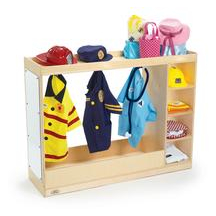
I've re-purposed it as a "Peace Corner." The Peace Corner can fit two or three children at the most. It is a space for "hiding," but, of course, we are still able to see who is in there for safety reasons. 
Behind the curtain there is a mirror, some pillows to make it cozy, and there are puppets for role-playing on the side shelves.


The following pictures are the resources I have printed and laminated for children. They are on the top shelf of the Peace Corner. 


The Peace Corner is a peaceful area for those children who need a quiet spot to calm down, or for a couple of children who need help solving a conflict.
This is not a space for "time-out." I am very firm about this. When I bring children to this area, I make sure to let them know they are not in trouble. This is a place of peace and problem-solving. For more information about my child-guidance philosophy, click here.


First the children may point to the picture that shows how they are feeling. If they are angry or frustrated, we read the Tucker Turtle story together.Tucker Turtle Takes Time to Tuck and Think is a free resource you can download here. It is a social story I use to teach children self-regulation.


After we read Tucker Turtle, the child or children may pick a solution from the Solution Kit. I organized the solutions by type of problem:

"If you want something someone else has, you may..."
"If someone else wants something you have, you..."
"If someone is bothering you, you may..."


The solution kit doesn't solve every problem out there, but with consistency it can become a means to teach the children that there are many ways to solve any given problem. Having three solutions available to choose from narrows it down for the children, and streamlines the process. 

You may now exit the Library/ Peace Corner.
:)

I will be posting more pictures of my classroom setup soon!

Happy playing!

Tuesday, April 10, 2012

How Does A Play-Based Classroom Teach Social and Emotional Skills?


You can learn many things from children.  How much patience you have, for instance. ~Franklin P. Jones

Part 2:

     Welcome to the second in my series “How Does a Play-Based Classroom Teach…?” The first in the series was Making a Portfolio for a Play-based Classroom, which stated the reasons for making a portfolio and how to organize it. Now you are going to join me in my process of actually making a play-based portfolio! My objective is to create a portfolio that will demonstrate the standards we meet through play.

     There is a reason that Social/Emotional skills are the first in the series, and also first in the Arizona Early Learning Standards. Social and Emotional Skills are a means of recognizing and controlling our feelings and interacting with other others. Those skills include:
  1. Self Confidence
  2. Recognizing and expressing emotions
  3. Self-control (stress management)
  4. Cooperation (Turn-taking/sharing)
  5. Respect for others (asking before taking)
     Children who have mastered these skills generally do better in a traditional classroom (and any social situation). However, as anyone who has experience with a 3-5 year old knows, these skills are difficult for many children! Yet these are the skills that--more than any other--will follow a child into every social interaction of his/her life!

     How scary is it to think that as parents and educators, we are responsible for teaching this ever-important skill set to each and every child we are responsible for?! It's not easy. There is no over-night fix. It will take time--and yes, extreme amounts of patience.

We take care of ourselves, first. 

I’ve come to a frightening conclusion that I am the decisive element in the classroom. It’s my personal approach that creates the climate. It’s my daily mood that makes the weather. As a teacher, I possess a tremendous power to make a child’s life miserable or joyous. I can be a tool of torture or an instrument of inspiration. I can humiliate or heal. In all situations, it is my response that decides whether a crisis will be escalated or de-escalated and a child humanized or dehumanized.”  -Haim G. Ginott

     The first step a teacher can take is to take care of him/herself. That means we as role-models must effectively be able to handle OUR OWN stress. Easier said than done, right? Here are a few ways teachers can take care of themselves: 
  • Know your limits. If you're feeling the stress knot building in your chest, it's time to take a potty break! Go in the bathroom and breathe in and out for a few minutes. It really helps!
  • Carry around a stress ball.

  • Make sure to get enough sleep each night. 
  • Eat right.
  • Exercise daily. 
  • Take deep breaths. All day long. It's magical. 
Above all, remember this: We want the children to feel safe in their environment. A teacher who yells a lot, and becomes easily frustrated does not set a good example of self control, or maintain a positive, safe environment.

We discuss feelings and emotions every day.
 
There are many tried-and-true ways of discussing feelings words with preschooler. I talk about how I am feeling all day long. When I'm happy, I tell them I'm happy. When I'm frustrated, I say, "I'm frustrated," and put myself in a quiet spot to take three deep breaths. I do this to:

     a) let the children know that is OK to have upset feelings (even teachers!), and 
     b) model an appropriate way of managing those feelings.

Other ways include:
  • Discussing feelings "in the moment."
  • Point to characters in stories during story time. "Uh-oh. Her fists are balled up, and she's stomping her foot. How do you think she's feeling right now?"
  • Sing songs and recite poems about feelings. A very popular song is "If you're happy and you know it." There is a poem that I love that is very similar to Eric Carle and Bill Martin Jr.'s Brown Bear, Brown Bear What Do You See? book.

         "Happy face, Happy Face,
         What do you see?
         I see a sad face looking at me.
         Sad face, Sad Face,
         What do you see?
         I see a surprised face looking at me! (and so on and so on....insert any emotion. Use facial   pictures that match each emotion to go with the poem!)
  • Use charts. This webpage has several free templates for you to download and print. I use them all the time, but you can always make your own! There is a feelings wheel, a feelings chart, and feelings posters. Why not use them all?

We help children to manage their stress.
Little ones get stressed, too! They have to share an environment with up to 20 other little humans, sharing toys, space, and attention with only 2-3 teachers. You also don't know what their home life is. The fact is, we don't know WHAT happens from the time they leave our doors to the time they are signed back in again, and it is our job to give them coping skills to deal with the situations life throws at us.
  • We provide a cozy space indoors and out to "escape" to for awhile. 
  • We model stress-coping mechanisms like deep breathing or finding a quiet spot. 

  • We wait for them to calm down before approaching them about how to fix the situation. 
  • We use tag-team approach when we find ourselves in a power-struggle with a child. 
  • We give lots of hugs and kisses. 
  • We tell them we love them, and it's okay to make mistakes. 
  • We offer positive choices as alternatives to hurting others, screaming, or throwing a good old-fashioned tantrum. 

What do you do to help teach social and emotional skills in your home or classroom? 
--------------------------------------------------------------------------------------------------------
As promised, here is a sample of what our portfolio would look like. This is the first strand in the Social Emotional Standard of the Arizona Early Learning Standards
Arizona Department of Education
Early Learning Standards
Ages 3-5 Years Old

Social Emotional Standard
Strand 1.        Knowledge of Self
         Self Awareness
              a)Demonstrates self-confidence
The children frequently measure, pour, and mix concoctions that are used in the classroom. We stretch paint with liquid starch, make flubber, play-dough, glarch, goop, oobleck, and also do cooking projects once a week.
     b)Makes personal preferences know to others
 (children participate in class surveys, in which they are able to mark with stick, name plate, or felt-tip markers.)
The children often participate in group surveys. We do simple surveys to see what colors the children are wearing, to find out how many boys and girls there are today, and also to vote for preferences. 

     c)Demonstrates knowledge of self-identity
Children are given time with mirrors to create self-portraits. Children also pick favorite art work to put in their portfolios. The child's name is used to label his/her cubby, nap mat, nap shelf, and art.
d)      Shows an awareness of similarities and differences between self and others


·         Recognition and Expression of Feelings

a)      Associates emotions with words and facial expressions
b)      Identifies and describes own feelings
Veronica made a self portrait, and dictated to me: "I made it with those eyeballs, and this hair, and with a smile because I like to small all the time. I feel joy. I feel peaceful." 
c)       Demonstrates refusal skills by saying "No" to/in harmful situations
d)      Expresses empathy for others 
Peyton helps her friend dress in one of the dress-up costumes. She helps him put his arm through the hole, and even assists him in zipping the outfit.


Tuesday, July 19, 2011

Glow Sticks in Big Boxes!

Fun with glow sticks just don't stop!
...especially when you have large boxes to create dark, cozy spaces.
The view from inside.
This is what it looks like with flash...The kids brought pillows and blankets inside to make it cozy.
This is what it looks like with no flash!
What is the purpose of glow sticks? I guess there is none, other than they are really fun! I guess that is what a play-based classroom is all about...learning while having FUN.
You can almost see their smiling faces. :)
Christopher connected several glow sticks together, building fine motor skills. The kids used the connectors to create bracelets, necklaces, and...
...a WHIP!


The shorter box was juuust big enough for the little ones to crawl into.
While the bigger box could comfortably fit 3 children, and still "close the doors," which was their favorite part, of course.
I had to take pictures through the cracks in the doors...which was pretty tricky!
If they weren't able to close the doors themselves, they had friends help (pro-social behavior). They also used heavy objects as props to hold the flaps shut (inquiry and problem solving). These are skills that were encouraged not through the teacher coaching...rather by simply adding to the environment. 
Children need cozy spaces to "get away" from the noisiness of a busy classroom. I experienced this first-hand, when I had an extra teacher. I crawled inside the smaller box (only half of my torso could fit), along with Braeden, and instantly, the noises from the classroom were muted. It was just me and Braeden, making happy faces with glow sticks.
All children need a space where they can "get away," even if it's just to explore glow sticks with your best buddies.
I love the bracelets!
As to be expected, there were a few scraps over who would get a turn...
...this was quickly remedied by the use of 3 minute sand timers (I had them flip them over twice so each group got a six minute turn).
But even this was not enough. I quickly realized we needed yet another dark, cozy space...
So I put a large table cloth over a table, added some carpet squares on the floor, and voila! Another dark, cozy area for glow stick play. It wasn't as dark as the boxes of course, but still fun. This photo was taken without the flash.
When parents came in to drop off a child, they would ask, "Where are all the kids?" :)
My classroom looked almost empty for three days, and with the lights off, it must have seemed that way!
This is a view from inside the large box. They finally opened the doors, and I got a few sneaky pictures of the glow stick magic...


Happy playing! 

Related Posts Plugin for WordPress, Blogger...