Showing posts with label classroom organization. Show all posts

Tuesday, August 20, 2013

A Play-Based Library and Peace Corner

It's official.
Summer is over!
My co-teachers and I have been working very hard (as I'm sure many of you have been) preparing for this time. 

Parent handbook? Check.
Operation: "Clean and Organize?" Check. 
Rearrange the classroom? Check. 
We got this!

We agonized about the room arrangement. I really wanted to create a bigger art studio, but my original plan meant we had to move the library. This just would not work! The only other corners in the room were near a bathroom or an exit (high-traffic areas), and we still wanted to preserve the peacefulness of the cozy area. We finally managed to come up with an arrangement that fit all of our needs.

 I am very pleased with how it turned out.  I expect it to change throughout the year. We will add photographs of the children, rotate books, and display art and documentation. I'm sure we may try twinkly lights, or perhaps add more soft things. 
Here is the beginning of a wonderful Library!

This is a commercially bought canopy  from Discount School Supply.
 This was originally a canopy, not an entrance way. I had to fold the fabric in the back in half three or four times, until it was tall enough for an adult to fit through. (I intended to create a child-sized entrance, but I plan on spending time reading to individual children in this center throughout the year. For this reason, I made it adult-friendly.) I safety-pinned the fabric to make it stay folded.

My classroom has a low, drywall ceiling (just under ten feet), so I used a screw-in hook to attach it.

I tied the sides with a bit of yarn, and taped the yarn to the sides of the adjacent shelves. The fabric covers the tape, so it is still aesthetically pleasing, but the children are less likely to pull it down. It has been two full weeks, and so far, so good. (Knocking on wood!)
The artificial plant, (see-through) lace, and authentic-looking couch add a cozy touch to our library. The children may read individually or in small groups (no larger than three or four).

The shelf with the lace curtain above was originally a piece of dress-up furniture. It has a shelf on top for storage, six hooks for hanging clothes, and four more shelves down the right side for more storage. It has a full-length mirror down the left, outer side, similar to this:
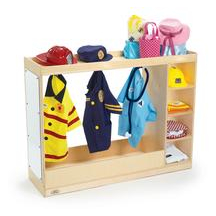
I've re-purposed it as a "Peace Corner." The Peace Corner can fit two or three children at the most. It is a space for "hiding," but, of course, we are still able to see who is in there for safety reasons. 
Behind the curtain there is a mirror, some pillows to make it cozy, and there are puppets for role-playing on the side shelves.


The following pictures are the resources I have printed and laminated for children. They are on the top shelf of the Peace Corner. 


The Peace Corner is a peaceful area for those children who need a quiet spot to calm down, or for a couple of children who need help solving a conflict.
This is not a space for "time-out." I am very firm about this. When I bring children to this area, I make sure to let them know they are not in trouble. This is a place of peace and problem-solving. For more information about my child-guidance philosophy, click here.


First the children may point to the picture that shows how they are feeling. If they are angry or frustrated, we read the Tucker Turtle story together.Tucker Turtle Takes Time to Tuck and Think is a free resource you can download here. It is a social story I use to teach children self-regulation.


After we read Tucker Turtle, the child or children may pick a solution from the Solution Kit. I organized the solutions by type of problem:

"If you want something someone else has, you may..."
"If someone else wants something you have, you..."
"If someone is bothering you, you may..."


The solution kit doesn't solve every problem out there, but with consistency it can become a means to teach the children that there are many ways to solve any given problem. Having three solutions available to choose from narrows it down for the children, and streamlines the process. 

You may now exit the Library/ Peace Corner.
:)

I will be posting more pictures of my classroom setup soon!

Happy playing!

Monday, August 6, 2012

Reggio-Emilia: How To Bring the Most Out of Your Early Learning Environment

My quest this year was to create a more organized, visually pleasing environment in our preschool classroom. My inspiration has come from various classes I've taken this year, inspirational teachers, cohort among local preschools, and of course, blogging! My research of other classrooms and personal aesthetic have led me to the Reggio Emilia approach to classroom environments. 


I do not claim to be a Reggio teacher. I have, however, learned to borrow bits and pieces from various pedagogical philosophies.

I do love how Reggio classrooms are designed to be a beautiful third teacher. If the environment is set up right, the children will be more likely to be actively engaged with the materials. Actively engaged children are learning through play. When children are engaged in activities, teachers have more time to positively interact with the children, observe the learning in action, write down language, and take pictures. Documentation is a HUGE part of the Reggio Emilia approach, but that is another blog post entirely!


In order to bring out the best of any classroom center, you must ask yourself. 
  • Are the materials easily accessible for young children? 
  • Are the materials clean and organized?
  • Are they labeled with a picture and words (preferably in two languages)? 
  • How does the center encourage mathematical concepts? Writing? Inquiry? Socio-emotional development? Easy clean-up?
  • Always ask yourself, "What else can this center offer? How can I make it better?" Remember: what works for one group of children may not work for another. I like to think that the classroom is never "done." There is always some project to add to your To-Do List to make your classroom the best learning environment possible. 

I met another teacher named Esther through my classes this semester who has challenged me to make the most out of my classroom environment. Esther allowed me to tour her center (which is a Reggio school), and even visited my classroom to give me tips. In return, I helped her with math. I completely got the better end of the deal! ;) She showed me how to look at the classroom from EVERY angle. 
  • Stand at the door way. Does your classroom look inviting? Does your classroom have an open layout? Are the centers clearly defined? Is it clear of clutter? Is there any furniture essentially blocking entrance to the classroom? 
  • Get down on your knees. This is the level that children stand at. Are materials easily within reach? Are the displays at eye level? Are the materials clean, organized and inviting?
  • Stand in every corner of the room. Are there any areas not visible? 
  • Stand by a window. Is there a way to take advantage of the natural light? Could you maybe move the art center so that the easel is near a window? What about the science center?
  • Look at the displays. Do you know the children, families, and teachers who share this space? Do you see pictures of the children? Are there unique pieces of art displayed in way that shows their work is valued? Is there anything to tell you what the children are studying this week besides the lesson plan? This brings us back to documentation. 
    • For more information on documentation in the Reggio Emilia approach, look here
    • This website has some wonderful insights on observation, assessment, and documentation. 
    • This writer gives tips on how they make learning visible

  • Look at the baskets. Are they bright, primary colors that detract from the brightly colored toys inside? Reggio environments typically take advantage of wicker baskets. You may also see containers that are  either neutral in color or clear. Examples include: pie tins, glass jars, clear plastic containers, white, black or brown baskets, and metal containers. The point isn't that wicker baskets are better than plastic ones! Neutral colors make the materials more eye-catching, and eye-pleasing. 

  • Have a seat. Is there a space for an adult to comfortably sit? Parents should feel welcome in the classroom. How can they get comfortable? 

  • How is the lighting? Are there alternatives to florescent lights? (Think floor lamps, shelf lamps, aquarium lights, or even white Christmas lights)! Is there a way to allow more natural light into the classroom?

I hope I've inspired someone to take another look at their early learning environment. This past year my classroom has changed quite a bit as I peek into what other people are doing around the world. What changes have you been inspired to make to your classroom? If you're interested in learning more about how to transform your preschool setting, consider reading Designs for Living and Learning: Transforming Early Childhood Environments by Deb Curtis and Margie Carter. It has gorgeous pictures of classrooms on every page!

Happy playing!

ms.ginasemail@gmail.com

Related Posts Plugin for WordPress, Blogger...